Guest Essay by Søren Ahrensborg Kamper | Star Wars: Gaming
That is not a failure of mapping. It is a reminder that location and meaning are not identical. In A Walk in the Park – Semantic Trajectories and Transition Diagrams, Günter Wallner shows how movement can be represented as a sequence of meaningful places rather than just raw coordinates. Such trajectories already tell us a great deal about where players go and in what order. The question here is narrower: what additional quest information could distinguish two visits to the same place when their practical roles in the story differ?
The same road, a different errand
Consider the peaceful branch of Tatooine’s Sand People quest. Getting into the enclave is only the beginning. HK-47, a droid capable of translating the chief’s words, makes negotiation possible. The chief asks for moisture vaporators from Czerka’s office in Anchorhead in exchange for reducing attacks on Czerka personnel. The player must leave, buy the equipment, and come back. A journey that began with a potentially hostile encounter becomes an errand whose importance depends on the agreement made at its destination1.
The resulting sequence is simple: Anchorhead, the Dune Sea and the enclave; a return to Anchorhead; then another journey out. A semantic transition diagram could retain the order of those places without plotting every footstep. But the first arrival opens a negotiation, the next journey acquires the requested equipment, and the final arrival fulfils the agreement. The places have not changed. Their role in the current quest state has.
This describes one available quest branch, not what every player does. Violence is also possible, and HK-47’s presence makes a particular diplomatic option accessible. A useful analytical label would therefore go beyond ‘enclave visited’ to include ‘negotiation possible’, ‘vaporators requested’ or ‘agreement fulfilled’. If the game recorded those events, the labels could be added to a movement visualization. The route alone cannot establish them with certainty.
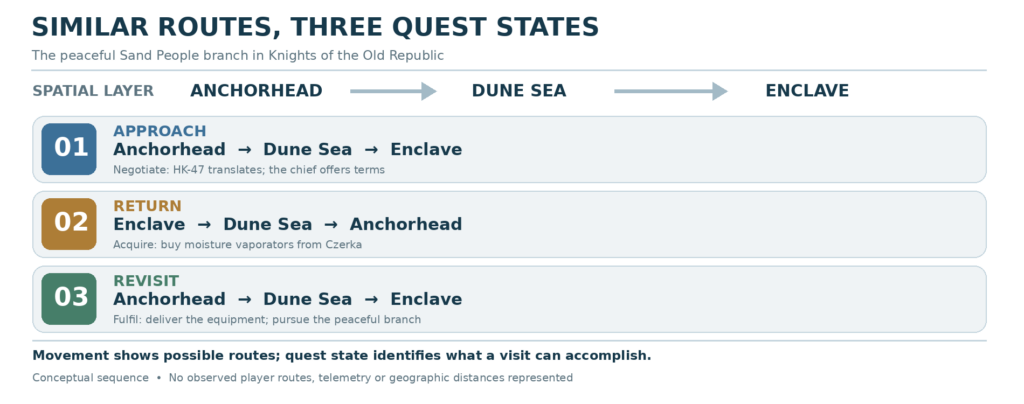
Figure 1. Conceptual sequence for the peaceful Tatooine quest branch. Similar routes between Anchorhead and the enclave have different functions as the objective changes.
On Coruscant, a destination becomes an argument
The distinction becomes clearer when we turn from the repeated journey on Tatooine to a branching destination on Coruscant in Star Wars: The Old Republic. Instead of following much the same corridor for different errands, a player can complete one mission by heading towards either of two places. The Old Galactic Market and Senate Tower are both recognizable destinations; the mission journal explains what has been recovered and why the choice of recipient matters.
In ‘The Senator’s Stolen Goods’, Heerimus, a representative of Senator Barc, asks the player to recover missing computer chips. Captain Denal-zon, encountered in the Old Galactic Market, explains that the chips operate illegal slave collars and asks that they be destroyed. After recovering seven chips, the player can deliver them to Denal-zon in the market or to the senator in the Senate Tower2. The collection objective is the same; the final destination and moral consequence are not.
Here movement data might reveal more than in the Tatooine example. A route from the recovered shipment to the Senate Tower could be consistent with returning the chips to Barc; a route back to Denal-zon suggests the alternative. In that sense, movement can reflect a narrative choice. Yet the destination alone does not prove that the chips were handed over there: the player might be travelling on another errand. An event recording the actual handover would be the more reliable indicator. Spatial evidence, quest state, and event data should therefore be treated as complementary forms of evidence.
The MMO format adds another complication. Taxi travel may replace continuous movement between areas with a jump between transport points, while players can take unrelated detours between objectives. A mission flowchart describes possible routes, not journeys anyone necessarily took. Without records of movement, we cannot estimate which paths players preferred, how often they returned or where they stopped. Even with movement records, the player’s reasons would remain an open question. This essay reads quest design closely; it does not claim to analyse player telemetry.
Better questions, not magical mind-reading
Wallner’s Game Data Mining and the Value of Visual Analytics distinguishes exploratory analysis, which helps identify patterns, from confirmatory analysis, which tests a prior hypothesis. Both are relevant here. Imagine that appropriately collected data showed frequent trips between Anchorhead and the enclave. A heatmap might highlight the busy corridor, while a semantic transition diagram could show repeated transitions between its areas. The quest offers a testable proposition: journeys made before and after the ‘obtain vaporators’ objective becomes active may look spatially similar but differ in the events associated with each visit.
An analyst could compare the sequences of areas visited before and after that objective change, and, if sufficiently detailed data existed, compare route choices and travel times as well. This would be more specific than merely counting visits to the enclave. Relevant event labels might include ‘HK-47 available to translate’, ‘vaporators purchased’ and ‘agreement completed’. On Coruscant, an event recording whether the chips were actually delivered to Senator Barc or Captain Denal-zon would provide a known outcome against which movement patterns could be checked. These events might not be logged at all, and any collection of player data should remain proportionate to the research question and mindful of privacy.
Such annotations would make the visualization richer, but they would still not answer every ‘why’. A quest-state label can tell us what the game allowed at a given moment; a movement trace can tell us which places a recorded player visited. Neither alone can tell us whether that player acted out of curiosity, frustration, role-playing conviction, or simple confusion. Understanding personal motivations would call for additional evidence such as interviews or player feedback, which may be difficult to gather outside a controlled study. The distinction is important: an explanation supported by game events is not the same as access to a player’s thoughts.
That is why close reading and visual analytics make useful allies. A designer’s quest structure can suggest categories worth recording; an actual dataset can test whether those categories illuminate observed movement. The two approaches answer different questions, and neither needs to impersonate the other. What matters is not a magical map that knows what players are thinking. It is asking what changed in the game’s state between one visit and the next, what the recorded data can show, and which interpretations still require further evidence. Sometimes the crucial difference between two journeys is not a new road. It is a promise made the first time, and kept the second.
1 StrategyWiki, Sand People Enclave – quest walkthrough.
2 TORCommunity, The Senator’s Stolen Goods – mission record.
Game-history background: Complete Star Wars Games Database (1979–Present) (Note: not a source of player telemetry)
Author: Søren Ahrensborg Kamper edits Star Wars: Gaming, an independent games-history publication.